DATAMATH CALCULATOR MUSEUM
|
DATAMATH CALCULATOR MUSEUM |
Texas Instruments PC-100A Printer Cradle
| Date of introduction: | 1976 | Display technology: | |
| New price: | $199.95 (SRP 1977), £209.00 | Display size: | |
| Size: | 10.4" x 11.3" x 4.1" | Printer technology: | Thermal TP-30250 |
| Weight: | 5 pounds 9 ounces | Serial No: | 8033070 |
| Batteries: | Date of manufacture: | wk 19 year 1977 | |
| AC-Adapter: | 120 V or 240 V | Origin of manufacture: | Netherland |
| Precision: | Integrated circuits: | TMC0251, TMC0561, TMC0569, 4*SN96912 | |
| Memories: | |||
| Program steps: | Courtesy of: | Joerg Woerner | |
| Download leaflet: |  (US: 2.3M Bytes)
 |
Download manual: |
(US: 3.3M Bytes) |
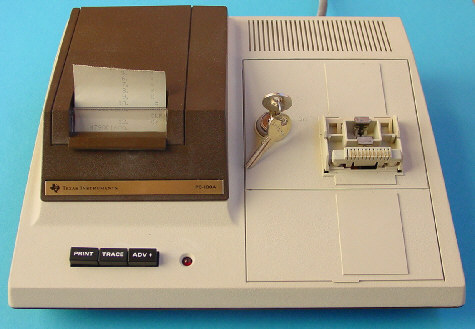
 The
PC-100A Printer Cradle followed the PC-100 within
a few months. It can be used with the
SR-52, SR-56, TI-58 and
TI-59 (not the TI-57).
Its thermal printer has 64 alphabetic, numeric and special characters which can be printed at the
rate of 60 characters per second. Up to 20 characters can be printed per line on
2.5 inch wide thermal paper.
The
PC-100A Printer Cradle followed the PC-100 within
a few months. It can be used with the
SR-52, SR-56, TI-58 and
TI-59 (not the TI-57).
Its thermal printer has 64 alphabetic, numeric and special characters which can be printed at the
rate of 60 characters per second. Up to 20 characters can be printed per line on
2.5 inch wide thermal paper.
The PC-100A can also be used to print, list or trace program steps as an aid to
debugging.
The PC-100A Printer Cradle in addition offers some extra features: It functions as a power-adapter and also has a storage/charging compartment where you can charge the battery pack. The calculator (and battery pack compartment) is locked solidly to the Printer Cradle with the use of a key.
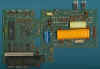 Dismantling
the PC-100A printing cradle reveals a rather complex printed circuit board (PCB)
based on the TMC0250 Printer/Display Chip from the
TMS0200 Chipset
for 12-digit Desktop Calculators and two additional
TMC0561 and
TMC0569 BROM (Bare Read Only Memories) Chips to support the SR-52 respectively SR-56 calculators.
Dismantling
the PC-100A printing cradle reveals a rather complex printed circuit board (PCB)
based on the TMC0250 Printer/Display Chip from the
TMS0200 Chipset
for 12-digit Desktop Calculators and two additional
TMC0561 and
TMC0569 BROM (Bare Read Only Memories) Chips to support the SR-52 respectively SR-56 calculators.
Don't miss the SR-60 using similar
components.
American Micro Products introduced with the
Module Selector a very interesting product
fitting into the charging bay of the PC-100A Printer Cradle.
 Although not officially supported by TI, several people were able to use the PC-100A with
SR-51 and SR-51A calculators by putting the PC-100A in
SR-52 mode. Some people found that the print mode worked fine with their SR-51s
but never could get the trace mode to work, getting an "1" and a "?" on the printout. Learn more about
Printing with the SR-51 / SR-51A.
Although not officially supported by TI, several people were able to use the PC-100A with
SR-51 and SR-51A calculators by putting the PC-100A in
SR-52 mode. Some people found that the print mode worked fine with their SR-51s
but never could get the trace mode to work, getting an "1" and a "?" on the printout. Learn more about
Printing with the SR-51 / SR-51A.
The SR-51-II cannot be connected to the PC-100A because of a redesign of the battery compartment.
Although some SR-50A have a Printer Cradle connector similar to the SR-51 and
it fits mechanically on the printer, was it apparently not preprogrammed for printout.
The successor of the PC-100A is the PC-100C which lacks the switch that makes it compatible with the SR-52 and
SR-56. The PC-100B was only a short time available, it
was a mixture of the old and new cradle.

If you have additions to the above article please email: joerg@datamath.org.
© Joerg Woerner, January 3, 2002. No reprints without written permission.