DATAMATH CALCULATOR MUSEUM
|
DATAMATH CALCULATOR MUSEUM |
Texas Instruments did not only invent the Integrated Circuit (IC) but demonstrated in 1967 with the Cal-Tech project that a portable electronic calculator can be designed using only 3 LSI circuits (Large Scale Integration) with a complexity of about 1,000 transistors, each and some additional shift registers for data storage. While rather large high-voltage Nixie tubes worked well with electronic desktop calculators, decided Texas Instruments to develop a compact, solid state thermal printer for the Cal-Tech feasibility study and when Canon introduced in April 1970 with the Pocketronic the first portable calculator based on Texas Instruments' LSI chips, it made consequently use of a serial thermal printer. Sanyo followed soon with the slightly larger ICC-82D using Nixie tubes while Sharp introduced in November 1970 the EL-8, an even smaller portable calculator using a VFD (Vacuum-Fluorescent-Display). Meanwhile Monsanto had developed with the MAN1 the first commercial available Seven-Segment LED Display with 0.27" (7 mm) character height using 14 individual GaAsP (Gallium Arsenide Phosphide) chips for the segments and 1 LED chip for the decimal point. Monsanto followed soon with the miniaturized MAN3 display with 0.115" (3 mm) character height that could be operated at currents as low as 1 mA per segment and was hence a perfect choice for electronic pocket calculators like the Bowmar 901B. When Texas Instruments announced on September 17, 1971 with the TMS1802NC the first available standard calculator building block on a chip, it was supported by two pre-configured Multi-Digit Calculator Numeric Seven-Segment LED Displays (DIS40, DIS95) based on the TIL360 arrays, the corresponding segment drivers (SN75491) and digit drivers (SN75492) and even the 1KS/6KS Klixon™ keyboard.
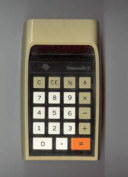
When Texas Instruments announced in April 1972 the TI-2500 Datamath portable calculator and the desktop models TI-3000 and TI-3500, the calculators used different display technologies. While the TI-2500 was using the red DIS40/DIS95 LED Displays, relied the two desktop models on orange gas-discharge displays with either 8 or 10-digits marketed by Burroughs as Panaplex™ display. Main disadvantage of these technologies was their high power consumption, later calculators switched VFD technology before finally replaced by LCDs (Liquid-Crystal-Displays).
With LED Displays being one of the main cost drivers in early portable electronic calculators, their manufacturing technology was changed multiple times over a rather short time span between 1971 and 1975 before more or less extinguished before the end of the Seventies.
Monsanto pioneered Seven-Segment LED Display based on individual GaAsP (Gallium Arsenide Phosphide) chips and introduced in 1971 with the MAN3 (clear epoxy, flat package) a very compact design with a housing of just 0.185" (4.7 mm) width, allowing very compact Multi Digit Display Modules having a character spacing of about 0.2" (5.1 mm). The more common MAN3A changed the color of the housing to a dark red epoxy, and introduced an inline package for through-hole mounting in addition to the flat package suitable for surface mounting. Both the dimensions and pin-out of the MAN3A evolved into a de facto standard and TI's DIS279 kept its dimensions while adding a small magnifying lens that the later DISXXX dropped.
| Type | Year | Number of Digits | Calculator | Comments |
| MAN3A | 1971 | 1 | Bowmar 901B | |
| DIS279 | 1973 | 1 | SR-10 Version 2, SR-50, SR-51 | |
| DISXXX | 1973 | 1 | SR-11 Version 1 |
First Multi-Digit Calculator Numeric Seven-Segment LED Displays with Right-Hand Decimals introduced together with the TMS1802NC single-chip calculator circuit. The Digit and Decimal GaAsP (Gallium Arsenide Phosphide) LED chips are mounted on a ceramic header which is then hermetically sealed with a glass cover. Character-to-character spacing is maintained when multiple displays are mounted end-to-end.
| Type | Year | Layout and # of Digits | Calculators | Comments |
| TIL360 | 1971 | 6 | Canon LE-10, SR-10 | |
| DIS40 | 1971 | 5 | TI-2500 | |
| DIS95 | 1971 | 4 | TI-2500 |
Work-in-Progress.
Work-in-Progress.
Work-in-Progress.
Work-in-Progress.
Work-in-Progress.
| Type | Year | Layout and # of Digits | Clocks | Comments |
| TIL370 | 1974 | 4 | TI-70, TI-71 |
Work-in-Progress.
| Type | Year | Number of Digits | Calculator | Comments |
| TIL233 | 1975 | 9 | TI-1200 | |
| TIL393-6 | 6 | |||
| TIL393-8 | 8 | |||
| TIL393-9 | 9 | |||
| DIS95 |
Work-in-Progress.
| Type | Year | Number of Digits | Calculator | Comments |
| SP-352 | 1972 | 2 | ||
| SP-353 | 1972 | 3 | Heathkit IC-2008A |
Work-in-Progress.
| Type | Year | Number of Digits | Calculator | Comments |
| Itron FG85CI | 9 | TI-1025, TI-1050 | ||
Work-in-Progress.
| Type | Year | Number of Digits | Calculator | Comments |

If you have additions to the above article please email: joerg@datamath.org.
© Joerg Woerner, 2021 - 2022. No reprints
without written permission.