DATAMATH CALCULATOR MUSEUM
|
DATAMATH CALCULATOR MUSEUM |
Texas Instruments TI-2600 Personal Banker
| Date of introduction: | 1987 | Display technology: | LCD |
| New price: | $50.00 (SRP 1988) | Display size: | 10 |
| Size: | 5.4" x 6.0" x 0.35" 136 x 152 x 9 mm3 |
||
| Weight: | 4.1 ounces,116 grams | Serial No: | |
| Batteries: | n.a. | Date of manufacture: | mth 11 year 1987 |
| AC-Adapter: | Origin of manufacture: | Taiwan | |
| Precision: | 10 | Integrated circuits: | Toshiba |
| Memories: | 1 | ||
| Program steps: | Courtesy of: | Joerg Woerner | |
| Download manual: |  (US: 9.1 MByte)
 |
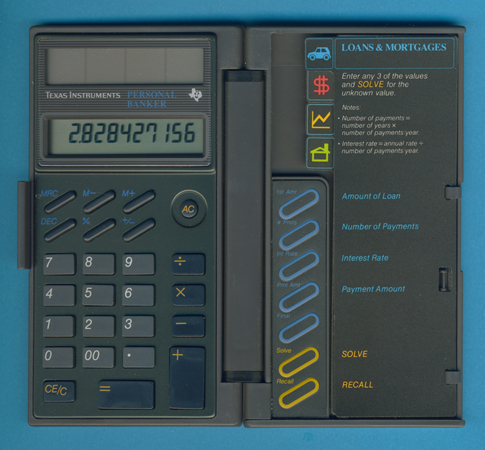
 The
Personal Banker followed the BA-SOLAR and uses four
different Help Cards to answer financial questions with ease and
convenience.
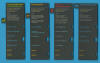
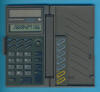
The picture on the left shows from top to bottom:
The
Personal Banker followed the BA-SOLAR and uses four
different Help Cards to answer financial questions with ease and
convenience.
The picture on the left shows from top to bottom:
| • Loans and Mortgages (without balloon payment) • Savings (with periodic deposits) • Investments (without periodic deposits) • Loans and Mortgages (with balloon payment) |
These cards can be rearranged if one application is used more often than the others.
 The
five financial keys, located on the right side of the calculator, correspond
with the values in a financial problem. When a financial key is pressed, a
corresponding indicator appears at the bottom of the display, and the number in
the display is stored in the financial registers.
The
five financial keys, located on the right side of the calculator, correspond
with the values in a financial problem. When a financial key is pressed, a
corresponding indicator appears at the bottom of the display, and the number in
the display is stored in the financial registers.
Pressing the [SOLVE] key followed by the financial key that represents
the unknown value solves the financial problem. With the [RECALL] key
followed by a financial key, the values from the financial registers could be
reused in other calculations.
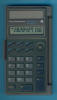
 The
innovative clamshell design of the Personal Banker allows its use as a compact
four function calculator, too.
The
innovative clamshell design of the Personal Banker allows its use as a compact
four function calculator, too.
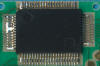
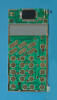
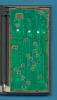 Dismantling
this Personal Banker manufactured in November 1987 by
Inventec Corporation in
Taiwan reveals a very clean design centered around an unknown Toshiba single-chip calculator circuit soldered on a double-sided printed circuit board (PCB) and powered by
two small LR44 batteries. The five extra
financial keys and [SOLVE] / [RECALL] keys are connected with a flexible PCB to the
main electronics.
Dismantling
this Personal Banker manufactured in November 1987 by
Inventec Corporation in
Taiwan reveals a very clean design centered around an unknown Toshiba single-chip calculator circuit soldered on a double-sided printed circuit board (PCB) and powered by
two small LR44 batteries. The five extra
financial keys and [SOLVE] / [RECALL] keys are connected with a flexible PCB to the
main electronics.
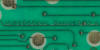 Inspecting
the PCB of this Personal Banker calculator brought our attention to a small mark reading IOPERSONAL BANKER-31D, we noticed similar marks already with other calculators manufactured by
Inventec Corporation and started compiling a list of the
PCB-Marks on calculators manufactured by OEMs for Texas Instruments.
Inspecting
the PCB of this Personal Banker calculator brought our attention to a small mark reading IOPERSONAL BANKER-31D, we noticed similar marks already with other calculators manufactured by
Inventec Corporation and started compiling a list of the
PCB-Marks on calculators manufactured by OEMs for Texas Instruments.
Another approach of a new human interface was developed with
the Business Edge in the same year. This
financial calculator features five
pressure-sensitive areas on the LCD-screen and displays the actual function
under these squares. The later
SC-10 used the right half of the foldable housing for a lot of scientific
keys.
Texas Instruments launched in 1987 a very innovative product line with the TI-2400 Phone Bank, TI-2600 Personal Banker, TI-2700 Mini Data Bank, and TI-2800 Paperless Printer followed till 1990 with the TI-2100 Pocket Info, TI-2900 Info Bank, TI-3100 Pocket Dialer, TI-3200 Pro Dialer, and TI-3400 EUROPA.
If you know the history of Texas Instruments it seems to commemorate the introduction of the TI-2500 Datamath a quarter century ago.

If you have additions to the above article please email: joerg@datamath.org.
© Joerg Woerner, July 22, 2002. No reprints without written permission.