DATAMATH CALCULATOR MUSEUM
|
DATAMATH CALCULATOR MUSEUM |
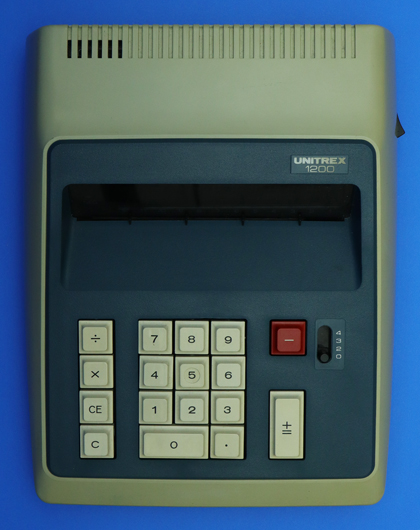
Unitrex 1200 (Type 37)
| Date of introduction: | January 1973 | Display technology: | Panaplex-style |
| New price: | Display size: | 12 + Sign | |
| Size: | 9.6" x 7.6" x
2.4" 245 x 194 x 62 mm3 |
||
| Weight: | 49.2 ounces, 1,395 grams | Serial No: | D37C09556 |
| Batteries: | n.a. | Date of manufacture: | mth 02 year 1973 |
| AC-Adapter: | 120 V | Origin of manufacture: | Japan |
| Precision: | 12 | Integrated circuits: | Mostek MK5011 |
| Logic: | Adding Machine | Displays: | JRC J4962E Septanix |
| Memories: | |||
| Program steps: | Courtesy of: | Joerg Woerner | |
| Download manual: |  (US: 1.5M Bytes)
 |
 Eiko Business Machine Co.,
Ltd. of Japan started manufacturing electronic calculators in November 1968 with
the Unitrex IC8 based on Mitsubishi's SSI
(Small Scale Integration DTL
(Diode-Transistor Logic) chips and a 96-bit
ferrite core memory. Eiko acquired in 1972 a stake in Cal-Tex Semiconductor, Inc., an American startup
company founded as designer and manufacturer of Custom LSI (Large Scale
Integration) PMOS (p-channel Metal–oxide Semiconductor) Integrated Circuits (ICs) with a strong focus on electronic calculators.
Cal-Tex first product was the CT5001, a drop-in replacement of Mostek's
MK6010 - exclusively available for Busicom and recognized as the World’s first single-chip calculator circuit.
Eiko Business Machine Co.,
Ltd. of Japan started manufacturing electronic calculators in November 1968 with
the Unitrex IC8 based on Mitsubishi's SSI
(Small Scale Integration DTL
(Diode-Transistor Logic) chips and a 96-bit
ferrite core memory. Eiko acquired in 1972 a stake in Cal-Tex Semiconductor, Inc., an American startup
company founded as designer and manufacturer of Custom LSI (Large Scale
Integration) PMOS (p-channel Metal–oxide Semiconductor) Integrated Circuits (ICs) with a strong focus on electronic calculators.
Cal-Tex first product was the CT5001, a drop-in replacement of Mostek's
MK6010 - exclusively available for Busicom and recognized as the World’s first single-chip calculator circuit.
As soon as the CT5001 was available, Eiko introduced in March 1972 with the Unitrex 1200 a very competitive 12-digit desktop calculator sold in various variants and iterations not only under Eiko's Unitrex, Frontier and Signet brands but through many OEMs like ABM, Blauring, Elite, Executron and Privileg. The Unitrex 1200 was soon complemented with the Model 1200M, adding a 4-function Memory to the feature set of the Model 1200 and based on Cal-Tex' CT5005, the World's first single-chip calculator circuit with Memory function.
We are not sure what went wrong in the relationship between Eiko and Cal-Tex but Eiko founded later in 1972 with Frontier Inc. a new company in the United States to develop their own calculator chips. The gap between retiring Cal-Tex chips in Eiko's product portfolio and ramping up the production of Frontier chips was filled with Mostek's LSI Chips and we know as of today five different generations of the Unitrex 1200/1200M desktop calculators and its derivations:
| Type | Model LSI Chip |
Model LSI Chip |
LSI Chip Manufacturer |
| Type 17 | 1200 CT5001 |
Cal-Tex | |
| Type 27 |
1200 CT5001 |
1200M CT5005 |
Cal-Tex |
| Type 37 | 1200 MK5011 |
1201M MK5013/MK5014 |
Mostek |
| Type 47 |
1200K FR1001 |
1202M FR1003 |
Frontier |
| Type 57 | 1202M tbd |
tbd |
We acquired this Unitrex 1200 (Type 37) calculator in 2025 on our
quest to understand the similarities and differenced of the Mostek ICs, Cal-Tex
ICs, and
Frontier ICs used with the Unitrex 1200/1200M Series calculators.
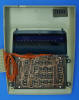
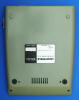 Dismantling
the featured Unitrex 1200 (Type 37) calculator manufactured in February
1973 in Japan
reveals a clean design based on a large single-sided printed circuit board
(PCB) for its electronics and power supply, a keyboard module and a display module.
Dismantling
the featured Unitrex 1200 (Type 37) calculator manufactured in February
1973 in Japan
reveals a clean design based on a large single-sided printed circuit board
(PCB) for its electronics and power supply, a keyboard module and a display module.
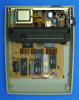 The
Main-PCB is centered around a Mostek MK5011 single-chip calculator
circuit and supported by four hybrid modules, four resistor network modules and
some discrete components located in the front half of the PCB. The rear quarter
of the PCB is occupied by the internal power supply, while the space between is
used for the Panaplex-style display module.
The
Main-PCB is centered around a Mostek MK5011 single-chip calculator
circuit and supported by four hybrid modules, four resistor network modules and
some discrete components located in the front half of the PCB. The rear quarter
of the PCB is occupied by the internal power supply, while the space between is
used for the Panaplex-style display module.
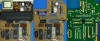 To
gain some knowledge about the differences between the Mostek MK5011 located in this
Unitrex 1200 (Type 37) and Cal-Tex' CT5001 used with the Unitrex 1200 (Type 27), we
decided here at the Datamath Calculator Museum to give it a "Teardown
Treatment" and sharing our findings accordingly.
To
gain some knowledge about the differences between the Mostek MK5011 located in this
Unitrex 1200 (Type 37) and Cal-Tex' CT5001 used with the Unitrex 1200 (Type 27), we
decided here at the Datamath Calculator Museum to give it a "Teardown
Treatment" and sharing our findings accordingly.
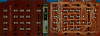
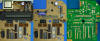 While
researching the Unicon 1200 and its siblings, we noticed many variants with not
only different housing shapes, housing colors, keyboard colors, but even changes of
the keyboard electronics, display modules and hybrid modules. We included in our
research a second Unitrex 1200 (Type 37) manufactured in September 1973.
While
researching the Unicon 1200 and its siblings, we noticed many variants with not
only different housing shapes, housing colors, keyboard colors, but even changes of
the keyboard electronics, display modules and hybrid modules. We included in our
research a second Unitrex 1200 (Type 37) manufactured in September 1973.
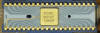 Calculating Unit:
The MK5011 used with the Unitrex 1200 (Type 37) is a member of Mostek's first
generation single-chip calculator circuits. Their Product Portfolio consisted in
Spring 1972 of three devices tracing back to the MK6010 developed for Busicom:
Calculating Unit:
The MK5011 used with the Unitrex 1200 (Type 37) is a member of Mostek's first
generation single-chip calculator circuits. Their Product Portfolio consisted in
Spring 1972 of three devices tracing back to the MK6010 developed for Busicom:
|
• MK5010 – 10-digit variation of the MK5012 • MK5011 – Original MK6010 design • MK5012 – Low-voltage version MK6010L |
 Display:
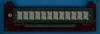
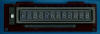
The featured Unicom 1200 (Type 37) calculator manufactured
in February 1973 makes use of a J4962E Septanix (Panaplex-style) display module
manufactured by Japan Radio Corporation (JRC) with a discrete neon lamp for the
minus sign and plugged
with its pins directly to a matching connector on the
Main-PCB. The second Unitrex 1200 (Type 37) calculator manufactured in September
1973 uses a pin-compatible JRC J4922Y Septanix display module (probably using Septanix II elements) and replaced the miniature gas-discharge lamp with an LED indicator.
Display:
The featured Unicom 1200 (Type 37) calculator manufactured
in February 1973 makes use of a J4962E Septanix (Panaplex-style) display module
manufactured by Japan Radio Corporation (JRC) with a discrete neon lamp for the
minus sign and plugged
with its pins directly to a matching connector on the
Main-PCB. The second Unitrex 1200 (Type 37) calculator manufactured in September
1973 uses a pin-compatible JRC J4922Y Septanix display module (probably using Septanix II elements) and replaced the miniature gas-discharge lamp with an LED indicator.
Display Driver: Early single-chip calculator circuits like General
Instrument's C-500, Mostek's MK6010 or Texas Instruments'
TMS0100 didn't include any display drivers
and left the choice of display technology and necessary interface circuitry to
the designers of the electronic calculators. The PMOS (p-channel Metal–oxide
Semiconductor) technology used with these chips was neither compatible with
Vacuum Fluorescent Displays (VFDs) nor with Led Emitting Diode (LED) Displays:
| • VF Display - Operating voltage (30 to 45 V) higher than chip voltage (15 to 25 V) • LED Displays - Operating current (10 to 50 mA per digit) higher than chip output current (1 to 5 mA) |
Planar neon gas discharge displays like the JRC Septanix modules or the more common Panaplex modules are operated with even higher voltages, typically around 180 Volts. To translate the "high-side" digit and segment drivers of the Mostek MK5011 chip, Unitrex is using hybrid modules from Kyodo Electronic Laboratories Inc., a subsidiary of Toko Inc. These encapsulated modules are using discrete transistors and resistors mounted on either a ceramic substrate or a simple PCB to translate the output signals of the MK5011 to the required operating voltages of the display module.
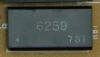
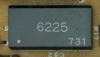 The dismantled
Unitrex 1200 (Type 37) calculators are using two Kyodo KH-6225 Digit Driver Modules connected with 12 high-voltage capacitors as level shifters to the twelve Digit Outputs D1 to D12 of the MK5011 chip and one Kyodo KH-6259 Segment Driver Module connected to the Segment Outputs SA
to SG and SDP of the MK5011 chip.
The dismantled
Unitrex 1200 (Type 37) calculators are using two Kyodo KH-6225 Digit Driver Modules connected with 12 high-voltage capacitors as level shifters to the twelve Digit Outputs D1 to D12 of the MK5011 chip and one Kyodo KH-6259 Segment Driver Module connected to the Segment Outputs SA
to SG and SDP of the MK5011 chip.
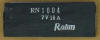
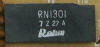
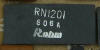
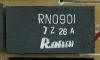 Most
input and output pins of the MK5011 single-chip calculator circuit are requiring
"pull-down" resistors for their operation, the Unitrex 1200 (Type 37) calculator
manufactured in February 1973 is using four Resistor Network Modules RN0901,
RN1201, RN1301, and RN1604 from R.ohm. The second Unitrex 1200 (Type 37)
calculator from September 1973 is showing the bare PCBs of these modules.
Most
input and output pins of the MK5011 single-chip calculator circuit are requiring
"pull-down" resistors for their operation, the Unitrex 1200 (Type 37) calculator
manufactured in February 1973 is using four Resistor Network Modules RN0901,
RN1201, RN1301, and RN1604 from R.ohm. The second Unitrex 1200 (Type 37)
calculator from September 1973 is showing the bare PCBs of these modules.
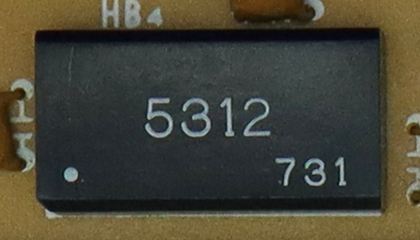 Clock: The
MK5011 single-chip calculator circuit of the Unitrex 1200 (Type 37) manufactured
in February 1973 is
operated with a frequency of about 25.7 kHz. The non-overlapping two-phase clock
signals are generated with
a Kyodo KB-5312 Clock Generator Module.
Clock: The
MK5011 single-chip calculator circuit of the Unitrex 1200 (Type 37) manufactured
in February 1973 is
operated with a frequency of about 25.7 kHz. The non-overlapping two-phase clock
signals are generated with
a Kyodo KB-5312 Clock Generator Module.
Power Supply: The Unitrex 1200 (Type 37) desktop calculator is powered by
a 120 Volts main outlet and uses an internal transformer with rectifiers,
transistors, zener diodes, resistors and capacitors to generate the required
voltages for the MK5011 and JRC Septanix module:
|
• VSS - Positive supply for
MK5011 (0 V) • VDD - Negative supply for MK5011 (-12.1 V) • VGG - Negative supply for MK5011 (-22.3 V) • VPP - Positive supply for J4962E (+91.6 V) • VDD - Positive supply for J4962E (+179 V) |
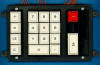 Keyboard:
The keyboard of the Unitrex 1200 (Type 37) uses 17 spring-loaded switches mounted directly on a
single-sided PCB together
with a 4-position sliding
switch the Decimal Point selection. A total of 18 diodes are used to convert the
ten number keys to the key inputs KN1 to KN4 (Numbers) of the MK5011, convert
the sliding switch position to the DP1 and DP2 inputs of the MK5011, and to
combine the [C] key with the power-on reset circuitry for the MK5011.
Keyboard:
The keyboard of the Unitrex 1200 (Type 37) uses 17 spring-loaded switches mounted directly on a
single-sided PCB together
with a 4-position sliding
switch the Decimal Point selection. A total of 18 diodes are used to convert the
ten number keys to the key inputs KN1 to KN4 (Numbers) of the MK5011, convert
the sliding switch position to the DP1 and DP2 inputs of the MK5011, and to
combine the [C] key with the power-on reset circuitry for the MK5011.
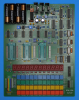 Here
at the Datamath Calculator Museum we use
the DCM-50A Platform to
Characterize and
Reverse-engineer
Single-chip Calculator Circuits. Many designs of electronic calculators do not
use all features of their calculator brains and it would be difficult to unleash
the full potential of the calculator chips in these cases. Additionally are
electronic calculators "closed systems" with limited flexibility to measure
signals, change voltages or clock frequencies, provide additional input keys or
even change the display technology or specifications additional digits. Core
idea of the DCM-50A is providing a generic platform to access all features of a
single-chip calculator circuit and with the
DCM-50A (PLAYGROUND) we
increased the scope from Texas Instruments products to offerings from their
competitors in the 1970s, namely AMI, Cal-Tex, Commodore/MOS Technology,
Electronic Arrays, Frontier, General Instrument, Hitachi, Litronix, Matsushita,
Mitsubishi, Mostek, National Semiconductor, NEC, Omron, RFT, Rockwell, Sharp,
Toshiba, and Western Digital.
Here
at the Datamath Calculator Museum we use
the DCM-50A Platform to
Characterize and
Reverse-engineer
Single-chip Calculator Circuits. Many designs of electronic calculators do not
use all features of their calculator brains and it would be difficult to unleash
the full potential of the calculator chips in these cases. Additionally are
electronic calculators "closed systems" with limited flexibility to measure
signals, change voltages or clock frequencies, provide additional input keys or
even change the display technology or specifications additional digits. Core
idea of the DCM-50A is providing a generic platform to access all features of a
single-chip calculator circuit and with the
DCM-50A (PLAYGROUND) we
increased the scope from Texas Instruments products to offerings from their
competitors in the 1970s, namely AMI, Cal-Tex, Commodore/MOS Technology,
Electronic Arrays, Frontier, General Instrument, Hitachi, Litronix, Matsushita,
Mitsubishi, Mostek, National Semiconductor, NEC, Omron, RFT, Rockwell, Sharp,
Toshiba, and Western Digital.
On our quest to document Mostek's MK6010 Chip and its
many descendants like the MK6010L, MK5010, MK5011, MK5012 and Cal-Tex' CT5001, CT5002, and
CT5012, we developed here at the Datamath Calculator Museum three additional
tools for our DCM-50A (PLAYGROUND):
| •
DCM-50A
(PLAYGROUND) MK6010 Adapter: Daughter Board for the
DCM-50A (PLAYGROUND)
Digit Inverter Frame Carrier for
Mostek's MK6010 Product Family • DCM-50A (PLAYGROUND) KBD102 Keyboard: Keyboard with 20 individual keys to support the MK6010-style BCD-Encoding keyboard input • DCM-50A (PLAYGROUND) Digilent I/O Extender: Plug-In Board to add six additional Input Signals for the Digilent Discovery |
Comparing the Calculator Logic Implementation of the MK5011 retrieved from the featured Unitrex 1200 (Type 37) calculator with the Calculator Logic Implementation of the CT5001 chip used with the Unitrex 1200 (Type 27) reveals only one subtle difference: Pressing the [C] or [CE] key lit up the display with all 12 digits showing '888888888888' with the MK5011 but '000000000000' with the CT5001. More importantly, all discovered Calculator Logic Bugs of the MK5011 are still present with the CT5001.
In a next step, we used a Logic Analyzer to compare the timing of the two single-chip calculator circuits and again, no differences. Even the pattern of how the MK5011 and CT5001 are "crashing" during a Divide by Zero operation is 100% identical.
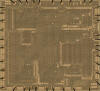 In our final attempt, we decided to "decap" both the
MK5011 and CT5001 chips salvaged from two Unitrex 1200
calculators and asked Sean Riddle to
provide us with high-resolution images of the silicon dies.
In our final attempt, we decided to "decap" both the
MK5011 and CT5001 chips salvaged from two Unitrex 1200
calculators and asked Sean Riddle to
provide us with high-resolution images of the silicon dies.
First surprise: The silicon die inside the MK5011 package is
marked with MK6010.
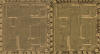 Second
surprise: The CT5001 chip looks almost identical to the MK6010 chip but wasn't
manufactured by Mostek. It proudly states "CAL-TEX" instead of "MOSTEK" but
analyzing its layout shows its PMOS transistors at the exact same positions with
only minor "cosmetic" differences in the metal interconnections.
Second
surprise: The CT5001 chip looks almost identical to the MK6010 chip but wasn't
manufactured by Mostek. It proudly states "CAL-TEX" instead of "MOSTEK" but
analyzing its layout shows its PMOS transistors at the exact same positions with
only minor "cosmetic" differences in the metal interconnections.
We assume that Cal-Tex was using a legal loophole to copy the MK6010 single-chip
calculator circuit:
|
• The design of the calculator logic was provided by Busicom to Mostek • Mostek converted the logic to a circuitry compatible with their PMOS process but didn't copyright it • The layout of the Chip couldn't be protected in the early 1970s |
It was not before 1984, when the United States passed the Semiconductor Chip Protection Act (SCPA), introducing a sui generis form of "industrial copyright" for "mask works". The unique law protect the layout design from being copied but allow for reverse engineering, unlike the traditional copyright.

If you have additions to the above article please email: joerg@datamath.org.
© Joerg Woerner, March 15, 2026. No reprints without written permission.