DATAMATH CALCULATOR MUSEUM
|
DATAMATH CALCULATOR MUSEUM |
Canon LE-10
| Date of introduction: | January 1972 | Display technology: | LED-modules |
| New price: | $259 | Display size: | 10 |
| Size: | 5.7" x 3.2" x 1.5" 146 x 82 x 38 mm3 |
||
| Weight: | 15.5 ounces, 440 grams | Serial No: | 158965 |
| Batteries: | 4*NiCd AA | Date of manufacture: | year 1972 |
| AC-Adapter: | Origin of manufacture: | Japan | |
| Precision: | 10 | Integrated circuits: | TMC1824, TMC1825A |
| Memories: | |||
| Program steps: | Courtesy of: | Joerg Woerner |
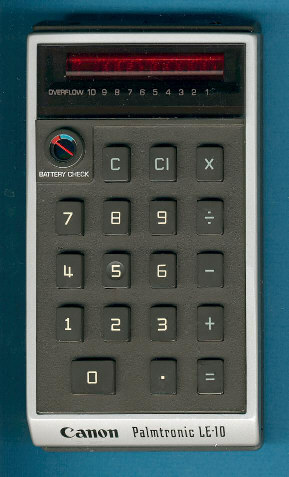
 When
Canon introduced in 1972 the LE-10 it was far ahead competition. The smart
housing accommodates not only the calculator chip set of the LE-100A
but even a rechargeable battery assembled of 4 AA-sized NiCd batteries.
When
Canon introduced in 1972 the LE-10 it was far ahead competition. The smart
housing accommodates not only the calculator chip set of the LE-100A
but even a rechargeable battery assembled of 4 AA-sized NiCd batteries.
 A
huge cradle holds the calculator during recharge-time of the internal
batteries. The small analogue battery meter gives you the remaining operation
time of the LE-10.
A
huge cradle holds the calculator during recharge-time of the internal
batteries. The small analogue battery meter gives you the remaining operation
time of the LE-10.
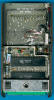
 Dismantling this Canon LE-10 calculator manufactured in 1972 reveals a genius masterpiece of Japan's engineering
capabilities. The internal construction of the LE-10 is based on a robust
chassis holding three printed circuit boards (PCBs) - two of them easily
removable for repairs:
Dismantling this Canon LE-10 calculator manufactured in 1972 reveals a genius masterpiece of Japan's engineering
capabilities. The internal construction of the LE-10 is based on a robust
chassis holding three printed circuit boards (PCBs) - two of them easily
removable for repairs:
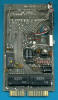 Main PCB with hybrid display drivers
and power supply.
Main PCB with hybrid display drivers
and power supply.
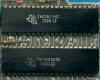 Calculator brain with the Texas
Instruments TMS1824 and TMS1825 chipset known from the Canon LE-100A.
Calculator brain with the Texas
Instruments TMS1824 and TMS1825 chipset known from the Canon LE-100A.
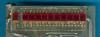 The Canon LE-10 followed the Pocketronic and uses red
LED-modules manufactured by Texas Instruments to display the 10-digit results
instead the serial thermal printer.
The Canon LE-10 followed the Pocketronic and uses red
LED-modules manufactured by Texas Instruments to display the 10-digit results
instead the serial thermal printer.
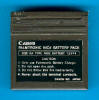 The
overall power consumption of the LE-10 dropped dramatically and the combined 13
rechargeable NiCd cells were replaced by s small module with just 4 cells.
The
overall power consumption of the LE-10 dropped dramatically and the combined 13
rechargeable NiCd cells were replaced by s small module with just 4 cells.
In Texas Instrument's history of
Integrated Circuits for calculators the LE-10
plays an important role. If you remember the three LSI-circuits of the Pocketronic, you will find in the LE-10 only two chips of a later generation but
one step towards the single-chip calculator chip.
| • TMC1824 - Data Chip • TMC1825A - ROM Chip |
The same chip set was used in the desktop calculator L100A introduced in the year 1971.
A special feature of the LE-10 is the 10-digit display
compared with the the successor LE-80
making use of the TMS0101 "calculator-on-a-chip" driving only an
8-digit display. It took some time before with the LE-100 again a 10-digit
calculator in the Canon’s pocket calculator line appeared. In the meantime some
odd calculators like LE-80M, LE-80R, LE-81
and LE-82
were introduced before the LE-83,
LE-84 and LE-85
settled the design line.
According to Shinichiro Osaki a later model carried the designation LE-10A. Differences are unknown but could be found in a LED display manufactured by Antex and provided by Amcon, Canon's subsidiary situated in Silicon Valley, California.
In 1974 the era of pocket calculators with LED displays was over in Japan and Canon introduced with the LD-80 their first product with the green VF-Display (Vacuum Fluorescent). Main advantage of this technology was that time both lower power consumption and cheaper purchase price. Interesting to know that Texas Instruments – manufacturing their own LED displays – introduced only few VFD calculators.Don't miss competition, the Sharp EL-811 and the later Toshiba BC-1205B sporting a 12-digit display.

If you have additions to the above article please email: joerg@datamath.org.
© Joerg Woerner, December 5, 2001. No reprints without written permission.