DATAMATH CALCULATOR MUSEUM
|
DATAMATH CALCULATOR MUSEUM |
Texas Instruments SR-22
| Date of introduction: | Sept.11, 1973 | Display technology: | Panaplex II |
| New price: | $350 | Display size: | 10+2 |
| Size: | 9.1" x 6.5" x 2.6" 232 x 165 x 67 mm3 |
||
| Weight: | 31.0 ounces, 881 grams | Serial No: | 5601 |
| Batteries: | BP-200 | Date of manufacture: | year 1974 |
| AC-Adapter: | AC9222 | Origin of manufacture: | USA |
| Precision: | 13 | Integrated circuits: | TMS0207, TMC0323, TMC0404 |
| Memories: | |||
| Program steps: | Courtesy of: | Joerg Woerner | |
| Download manual: |  (US: 1.8M Bytes)
 |
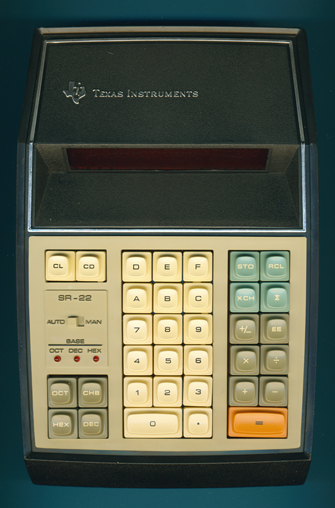

 Look
carefully at the display of the SR-22 and you'll notice immediately that this
calculator could perform amazing calculations. It is the only calculator reported
so far to perform
Octal-Decimal-Hexadecimal conversions on the base of floating point numbers.
Later calculators like the TI Programmer
work only on integer numbers.
Look
carefully at the display of the SR-22 and you'll notice immediately that this
calculator could perform amazing calculations. It is the only calculator reported
so far to perform
Octal-Decimal-Hexadecimal conversions on the base of floating point numbers.
Later calculators like the TI Programmer
work only on integer numbers.
The SR-22 is one of the few scientific desktop calculators manufactured by Texas Instruments. It uses a housing with the size of a TI-3500 but the extreme wedge shape of the SR-10.
 Dismantling
this SR-22 manufactured early in 1975 reveals a very rigid construction based on
one rather complex printed circuit board (PCB) with two satellites:
Dismantling
this SR-22 manufactured early in 1975 reveals a very rigid construction based on
one rather complex printed circuit board (PCB) with two satellites:
| • The Panaplex II display
manufactured by Burroughs. • The keyboard assembly with the keys, slider switch and discrete LED's. |
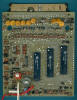 The
Main-PCB itself consists of four major building blocks:
The
Main-PCB itself consists of four major building blocks:
| • Upper part | Discrete high-voltage drivers for the Panaplex II display. |
| • Middle-left | Clock circuit |
| • Lower-left | Voltage supply |
| • Middle-right | Calculating circuit |
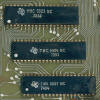 The
calculating circuit is formed by an impressive trio of 40-pin Integrated
Circuits based on the TMS0200 Chipset for 12-digit desktop calculators introduced in 1973 for
products like the
TI-4000 and TI-450. Most of
the known designs use only two chips, the TMS0200
Data Chip and the TMS0300
ROM Chip. Only this SR-22 and the massive TI-620 are
known as of today using the TMC0400
ROM/Register Chip to double the program capacity from 512*13 Bits to 1k*13 Bits
and adding two extra 16-digit Registers to the four Registers incorporated in
the TMS0200 Data Chip.
The
calculating circuit is formed by an impressive trio of 40-pin Integrated
Circuits based on the TMS0200 Chipset for 12-digit desktop calculators introduced in 1973 for
products like the
TI-4000 and TI-450. Most of
the known designs use only two chips, the TMS0200
Data Chip and the TMS0300
ROM Chip. Only this SR-22 and the massive TI-620 are
known as of today using the TMC0400
ROM/Register Chip to double the program capacity from 512*13 Bits to 1k*13 Bits
and adding two extra 16-digit Registers to the four Registers incorporated in
the TMS0200 Data Chip.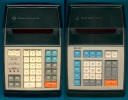
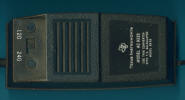 The same housing was used with the simpler SR-20
calculator, while the huge power supply AC9222 was exclusively designed for the
SR-22.
The same housing was used with the simpler SR-20
calculator, while the huge power supply AC9222 was exclusively designed for the
SR-22.
If you have additions to the above article please email: joerg@datamath.org.
© Joerg Woerner, December 5, 2001. No reprints without written permission.