DATAMATH CALCULATOR MUSEUM
|
DATAMATH CALCULATOR MUSEUM |
Texas Instruments TI Programmer
| Date of introduction: | August 1977 | Display technology: | LED-stick |
| New price: | $42.50, DM198.00 | Display size: | 8 (5 + 2) |
| Size: | 5.8" x 3.1" x
1.4" 148 x 78 x 36 mm3 |
||
| Weight: | 4.0 ounces, 114 grams | Serial No: | |
| Batteries: | BP8 | Date of manufacture: | wk 18 year 1980 |
| AC-Adapter: | AC9132 | Origin of manufacture: | Italy |
| Precision: | Integrated circuits: | TMC0983 (ZA0675) | |
| Logic: | AOS - 4 Pending Operations, 15 () | ||
| Memories: | 1 | ||
| Program steps: | Courtesy of: | Joerg Woerner | |
| Download leaflet: |  (US: 0.9M Bytes)
 |
Download manual: |
(US: 5.0M Bytes) |
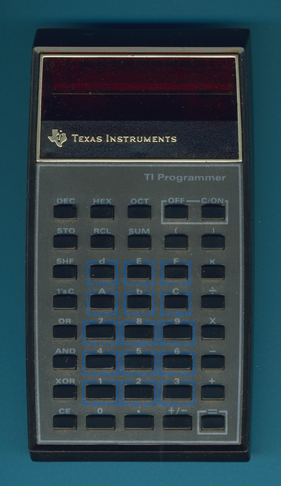

 The
TI Programmer is a very unusual calculator doing math not only on the base-10
system like our natural life but on base-8 and base-16, too. Long before
SW-engineers got nice languages like JAVA or C++ they were used to program the
microcontrollers in their native assembler languages. The only things such a
microcontroller is executing are simple instructions to manipulate data. With
the TI Programmer you could simulate these operations, e.g. AND, OR, XOR and
SHIFT's in the data-format of modern microcontrollers (hex or base-16) or
old-fashioned minicomputers (octal or base-8).
The
TI Programmer is a very unusual calculator doing math not only on the base-10
system like our natural life but on base-8 and base-16, too. Long before
SW-engineers got nice languages like JAVA or C++ they were used to program the
microcontrollers in their native assembler languages. The only things such a
microcontroller is executing are simple instructions to manipulate data. With
the TI Programmer you could simulate these operations, e.g. AND, OR, XOR and
SHIFT's in the data-format of modern microcontrollers (hex or base-16) or
old-fashioned minicomputers (octal or base-8).
From the technical aspects the TI Programmer is nothing else than a TI-30
with a different calculator chip (TMC0983/ZA0675 instead the TMC0981).
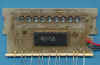 The
TI Programmer and all
other (except the SR-51-II and TI-45) calculators in the Majestic-line used a LED-stick carrying the whole
electronics! If you dismantle such a calculator you'll find the LED-stick, one
resistor and one integrated circuit in a 28 pin housing. The electronics of
the TI-Programmer is centered around a TMC0983 circuit, a member of the
TMC0980
single-chip calculator family, while the TI-45 uses a chip from the
TMC1980
family. Both designs are based
on the TMS1000 Microcomputer
series with an increased memory capacity of 18,432 Bits Read-Only Memory (ROM, 2k*9 Bits) and 576 Bits Random-Access Memory (RAM, 9 Registers * 16 digits). Main differences between the TMC0980 and TMC1980 are the display
drivers - while the former supports LED displays, adds the latter high-voltage
drivers for Vacuum Fluorescent Displays (VFD). In addition includes the TMC1980 both an integrated charge pump driver to generate the high voltage (around -22V) for the Anodes and Grids of the VF-Display and integrated drivers for the Filament (heater)
allowing for reasonable manufacturing costs.
The
TI Programmer and all
other (except the SR-51-II and TI-45) calculators in the Majestic-line used a LED-stick carrying the whole
electronics! If you dismantle such a calculator you'll find the LED-stick, one
resistor and one integrated circuit in a 28 pin housing. The electronics of
the TI-Programmer is centered around a TMC0983 circuit, a member of the
TMC0980
single-chip calculator family, while the TI-45 uses a chip from the
TMC1980
family. Both designs are based
on the TMS1000 Microcomputer
series with an increased memory capacity of 18,432 Bits Read-Only Memory (ROM, 2k*9 Bits) and 576 Bits Random-Access Memory (RAM, 9 Registers * 16 digits). Main differences between the TMC0980 and TMC1980 are the display
drivers - while the former supports LED displays, adds the latter high-voltage
drivers for Vacuum Fluorescent Displays (VFD). In addition includes the TMC1980 both an integrated charge pump driver to generate the high voltage (around -22V) for the Anodes and Grids of the VF-Display and integrated drivers for the Filament (heater)
allowing for reasonable manufacturing costs.
Simply by comparing the designation of the integrated circuits of the entry line "Majestic" calculators, you'll get the all members of this family:
|
• TMC0980
Goulds
Pumpulator uses a custom design ROM (CD9801) Digging deeper into the TMC098x calculator chips you'll locate an OEM-chip used on a TI-30 "clone" manufactured in Hong Kong: • TMC0985 Amelia Scientific 2001 |
The TI Programmer wasn't the first calculator from Texas Instruments dealing with hexadecimal numbers, view the odd SR-22.
The TI Programmer was replaced in 1982 with the LCD Programmer based on the luckless TI-55-II.
| TI Programmer:
Efficient, time saving solutions for computer programming professionals and hobbyists. Hexadecimal. Octal. Decimal. Texas Instruments new TI Programmer lets you perform fast, accurate conversions and calculations in any of these number bases...portable power you can apply right to the job, right where the job is. Number base conversions. Enter a number in base 8, 10 or 16, Then with a touch of a key, that number is quickly and accurately converted to either of the other number bases. Results appear instantly on the TI Programmer's bright, easy-to-read LED display. And a convenient mode indicator means you always know what number base you're operating in. Number base calculations. The TI Programmer quickly handles arithmetic computations, too - in all three bases. Immediate answers to binary computer problems...giving you more time for important programming or troubleshooting tasks. Ideal for use with any size computer. TI Programmer gives
you 8-digit capacity in all bases...capability to handle even IBM 370
problems with ease. And since the TI Programmer uses integer "two's
complement" arithmetic in hexadecimal and octal bases, it operates
naturally, just like computers does. Decimal base features signed floating
point arithmetic for convenience day-to-day math. [1'sC] key provides
"one's complement" capability in HEX and OCT bases. Versatile three key memory. Three-key memory lets you store, recall or sum to memory contents. Parantheses provide the capability to specify the order of operation execution in a problem - with up to 4 pending operations. The TI Programmer even handles mixed number bases and combined logical and arithmetic operations; conversions and operations take place in the order you specify. Constant mode allows constant operations with all arithmetic and logical operations. © Texas Instruments, 1977 |
| TI Programmer
Efficient, time saving solutions for computer programming professionals or hobbyist. Hexadecimal. Octal. Decimal. Performs fast, accurate conversions and calculations in any of these number bases. Enter a number in base 8, 10 or 16. TI Programmer can quickly convert to either of the other bases. Rapidly handle arithmetic computations in all three bases. Ideal for use with any size computer. TI Programmer uses integer
"two’s complement" arithmetic in hexadecimal and octal bases. Three key memory lets you store, recall, or sum to memory contents. Decimal base features signed floating point arithmetic for convenience in day-to-day math. Can multiply the effectiveness of anyone in computer programming. © Texas Instruments, 1981 |
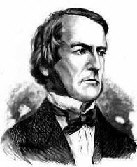 Mathematician and logistician who developed ways of expressing logical
processes using algebraic symbols, creating a branch of mathematics known as symbolic logic.
Mathematician and logistician who developed ways of expressing logical
processes using algebraic symbols, creating a branch of mathematics known as symbolic logic.
Born in Lincoln, England on November 2, 1815, George Boole was the son of a poor shoemaker. As a child, Boole
was educated at a National Society primary school. He received very little formal education, but was determined to become self-educated.
When he was merely sixteen, Boole became an assistant teacher at an elementary school, and he founded his own school four years later. When
Boole opened his school, he also began seriously studying mathematics. His desire to
pursue math was inspired in part by his frustration at using inferior math texts to educate his pupils. This frustration led Boole to forever alter the world of
numbers.
By 1840, only five years after he began studying math, Boole was creating original work. In 1844, a paper he wrote on the calculus of operators
was given a gold medal by the Royal Society. This honor secured recognition for Boole from British mathematicians. His reputation was greatly
enhanced in 1847 when he published The Mathematical Analysis of Logic, a short volume that first introduced Boole's early ideas on symbolic logic
to the world. The publication demonstrated that logic, as presented and verbalized by Aristotle, could be rendered as algebraic equations. As
expressed by Boole, "We ought no longer to associate Logic and Metaphysics, but Logic and Mathematics." Indeed, numbers may be the
truest representation of logic known to humanity.
1849 marked a significant change in Boole's life, when he was appointed professor of mathematics at Queen's College in Cork, Ireland. He
became chair of mathematics, and taught at the school the rest of his life. The school later became known as University College Cork.
In 1854, Boole published An Investigation of the Laws of Thought, on Which Are Founded the Mathematical Theories of Logic and
Probabilities. This work
expounds upon his earlier work, and contains the concepts which have come to be known collectively as Boolean algebra. He was named a
fellow of the Royal Society in 1857, and Boole's 1860 publication on the calculus of finite differences has become a seminal work in that field.
Boole married Mary Everest in 1855, and they had five daughters together before his death from pneumonia on December 8, 1864. In 1847,
George Boole observed that the importance of his work would vary, determined primarily by the fields in which his theories found application.
Today, Boole's texts on symbolic logic are used extensively not only in the teaching of mathematics, but also in information theory, switching
theory, graph theory, computer science, and artificial intelligence research.
Copyright © 1994-99 Jones International and Jones Digital Century

If you have additions to the above article please email: joerg@datamath.org.
© Joerg Woerner, December 5, 2001. No reprints without written permission.