DATAMATH CALCULATOR MUSEUM
|
DATAMATH CALCULATOR MUSEUM |
With the TMS0952 Texas Instruments introduced in the year 1975 the first "real" single-chip calculator design based on the TMS1000 family. In opposite to the TMS0102 with the discrete segment- and digit-drivers or the TMS0803 with the external digit-drivers this design controlled the seven-segment display directly. The chip integrates 8192-bit read-only program memory (ROM), a 256-bit random-access memory (RAM) and a decimal arithmetic logic unit as well as control, timing, and output decoders plus drivers for the display. This adds up to an overall complexity of roughly 8000 transistors.
Due to a flexible design concept with a programmable ROM some design variations appeared. Compare this IC with the TMS0954 and the later TMS0972. Please find a pictures with all three calculator chips here.
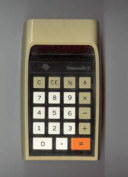
A typical calculator built around the TMS0952 family performs the four basic functions +,-,*,: and adds the %-function and a four-key memory, the later TMC0980 allowed for both scientific and financial calculators with up to 40 keys.
| Type | Calculators | Digits |
| TMS0952 | TI-1200, TI-1250 | sign + 8 |
| TMS0954 | TI-1260 | sign + 8 |
| TMS0972 | TI-1200, TI-1250 | 8 or sign + 7 |
| TMS0974 | TI-1270 | 8 or sign + 7 |
| TMS0975 | Little Professor (1976) | 8 |
| TMC0904 | Milton Bradley COMP IV | 0 + 10 LEDs |
| TMC0905 | Parker Brothers Code Name:Sector | 6 + 4 LEDs |
| TMC0907 | Wiz-A-Tron (1977) | 8 |
| Item | Min | Typ | Max | Unit | Comments |
| VSS | 0 | V | |||
| VDD | -9.0 | V |
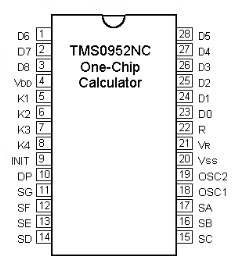
The TMS0952 uses a standard 0.6” wide 28-pin DIP (Dual In-line Package with a 0.1” / 2.54 mm lead pitch).
| Pin | IO | Function | Pin | IO | Function |
| 1 | O | Digit driver 6 | 28 | O | Digit driver 5 |
| 2 | O | Digit driver 7 (MSD) | 27 | O | Digit driver 4 |
| 3 | O | Digit driver 8 (sign) | 26 | O | Digit driver 3 |
| 4 | V | Negative Voltage VDD | 25 | O | Digit driver 2 |
| 5 | I | Keymatrix input 1 | 24 | O | Digit driver 1 |
| 6 | I | Keymatrix input 2 | 23 | O | Digit driver 0 |
| 7 | I | Keymatrix input 3 | 22 | R | 6k8-VDD |
| 8 | I | Keymatrix input 4 | 21 | V | Ref voltage |
| 9 | I | Key or power on reset | 20 | V | Common Voltage |
| 10 | O | Segment driver DP | 19 | I | Clock mode |
| 11 | O | Segment driver G | 18 | I | Clock input |
| 12 | O | Segment driver F | 17 | O | Segment driver A |
| 13 | O | Segment driver E | 16 | O | Segment driver B |
| 14 | O | Segment driver D | 15 | O | Segment driver C |
| The Segment drivers A-G and the Decimal point are connected to a display in the pictured way. | 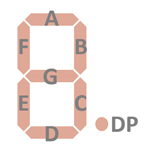 |
The keyboards of all calculators based on the TMS0952 family consist of an x/y-matrix connected to six segment-driver outputs and the keymatrix inputs K1 to K4. The Power on reset is usually not connected to a key.
| K1 | K2 | K3 | K4 | |
| Seg. DP | MC | MR | M- | M+ |
| Seg. F | C | +/- | % | : |
| Seg. E | 7 | 8 | 9 | * |
| Seg. D | 4 | 5 | 6 | - |
| Seg. C | 1 | 2 | 3 | + |
| Seg. B | CE | 0 | . | = |
Calculators based on the TMS0952 make use of a 9-digit LED-display with common cathode architecture. The TI-1200 uses the LED-stick 233.

If you have additions to the above datasheet please email: joerg@datamath.org.
© Joerg Woerner, February 02, 2001. No reprints
without written permission.