DATAMATH CALCULATOR MUSEUM
|
DATAMATH CALCULATOR MUSEUM |
Texas Instruments Language Tutor
| Date of introduction: | January 1980 | Display technology: | Fluorescent |
| New price: | $150 | Display size: | 10 alphanumeric |
| Size: | 8.0" x 3.4" x 1.25" 202 x 87 x 32 mm3 |
||
| Weight: | 10.1 ounces, 286 grams | Serial No: | 1542 |
| Batteries: | 4*AA cells | Date of manufacture: | wk 47 year 1979 |
| AC-Adapter: | AC9199 | Origin of manufacture: | USA (MTA) |
| Precision: | Integrated circuits: | TMC0275, TMC0280 + Module: 4*TMC0350 | |
| Memories: | |||
| Program steps: | Courtesy of: | Joerg Woerner | |
| Download manual: |
 (FRENCH US: 6.2M Bytes)
(GERMAN US: 14.5M Bytes)
(SPANISH US: 13.7M Bytes)
(FRENCH US: 6.2M Bytes)
(GERMAN US: 14.5M Bytes)
(SPANISH US: 13.7M Bytes) |
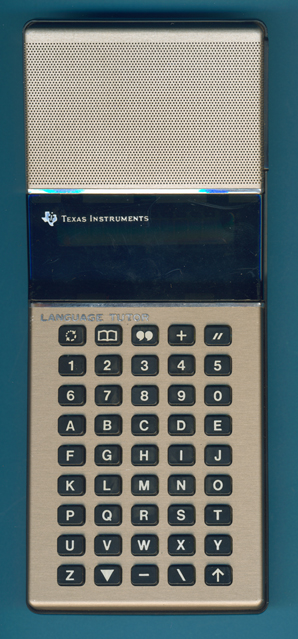

 Shortly
after the invention of the synthesizer technology to reproduce human speech with
tuned voices stored in ROMs (Read Only Memories - Integrated Circuits), the
Language Translator was
introduced. The product was later renamed to Language
Tutor and both products were marketed in parallel. With the Language Teacher a
cheaper version without the speaker was introduced the same time.
Shortly
after the invention of the synthesizer technology to reproduce human speech with
tuned voices stored in ROMs (Read Only Memories - Integrated Circuits), the
Language Translator was
introduced. The product was later renamed to Language
Tutor and both products were marketed in parallel. With the Language Teacher a
cheaper version without the speaker was introduced the same time.
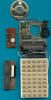 Dismantling
this Language Tutor manufactured in November 1980 by Texas instruments in its
Abilene, TX facility reveals a printed circuit board (PCB) identical to the
Language Translator.
Dismantling
this Language Tutor manufactured in November 1980 by Texas instruments in its
Abilene, TX facility reveals a printed circuit board (PCB) identical to the
Language Translator.
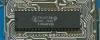
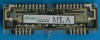 The
design is centered
around a TMC0270 single-chip microcontroller known already from the
Speak & Spell and a TMS5110 Voice Synthesis Processors (VSP).
From a technical point of view the TMC0270 is very similar to the
TMS0980 best known from the
TI-30 calculator but optimized for 14-segment VF-Displays instead of 7-segment LED-displays.
The PCB of the Language Tutor holds the two Integrated Circuits, a
10-character VF-Display, a small PCB with the power supply, a connector for the "Language Modules" and connects to
the keyboard with 45 keys:
The
design is centered
around a TMC0270 single-chip microcontroller known already from the
Speak & Spell and a TMS5110 Voice Synthesis Processors (VSP).
From a technical point of view the TMC0270 is very similar to the
TMS0980 best known from the
TI-30 calculator but optimized for 14-segment VF-Displays instead of 7-segment LED-displays.
The PCB of the Language Tutor holds the two Integrated Circuits, a
10-character VF-Display, a small PCB with the power supply, a connector for the "Language Modules" and connects to
the keyboard with 45 keys:
|
•
TMC0275: 4-bit microcontroller with 2k*9 Bits ROM and 9*64 Bits RAM • TMC0280/CD2801: TMS5110 VSP (Voice Synthesis Processor) |
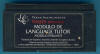
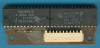
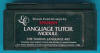
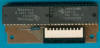
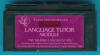
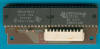
An easy accessible "Solid State Speech™ Module" contains the software to translate from e.g. English, French and Spanish to spoken German. Other modules to translate to spoken English, French or Spanish were available. Texas Instruments announced optional modules in Russian, Chinese and Japanese for $50, each. We don't know if these modules were actually introduced. These Speech Modules contain a total of four TMC0350 Read Only Memories (ROMs) - also known as Voice Synthesis Memories TMS6100 - with 128k Bits, each.
|
• TMC0350/CD2311, CD2312, CD2313, CD2314 (American Voice): TMS6100 VSM (Voice Synthesis Memory) with 128k Bits, each • TMC0350/CD2315, CD2316, CD2317, CD2318 (Spanish Voice): TMS6100 VSM (Voice Synthesis Memory) with 128k Bits, each • TMC0350/CD2327, CD2328, CD2329, CD2330 (French Voice): TMS6100 VSM (Voice Synthesis Memory) with 128k Bits, each • TMC0350/CD2331, CD2332, CD2333, CD2334 (German Voice): TMS6100 VSM (Voice Synthesis Memory) with 128k Bits, each • TMC0350/CD3526, CD3527, CD3528, CD3529 (British Voice): TMS6100 VSM (Voice Synthesis Memory) with 128k Bits, each |
Language |
Speech Module |
Speech ROMs |
| English |
 |
 |
| Spanish |
 |
 |
| German |
 |
 |
From a technical point of view the Language Tutor and Translator are very similar to the Speak & Spell, nevertheless was its suggested retail price about 3 to 5 times higher.
A typical Solid State Speech Module, for example the French Word/Phrase module, stores 360 individual words and 78 phrases that are spoken and displayed and additional 239 individual words that are only displayed. The phrases are available with the input of a two-digit number, e.g. "19" means "What is this?".
To create complete sentences you could link phrases together: "7" + "209" + "433" will give you the French translation of "I would like" "a" "room".
The individual words are entered letter by letter and translated to the target language. Six possibilities were available, but each module could "speak" only one language:
Mode |
FRENCH Module |
||
| Keyboard | Display | Speaker | |
| FRAN-ESPA | French | Spanish | n.a. |
| DEUT-FRAN | German | French | French |
| FRAN-ANGL | French | English | n.a. |
| ESPA-FRAN | Spanish | French | French |
| FRAN-ALLE | French | German | n.a. |
| ENGL-FREN | English | French | French |
Mode |
SPANISH Module |
||
| Keyboard | Display | Speaker | |
| ENGL-SPAN | English | Spanish | Spanish |
| FRAN-ESPA | French | Spanish | Spanish |
| DEUT-SPAN | German | Spanish | Spanish |
| ESPA-INGL | Spanish | English | n.a. |
| ESPA-FRAN | Spanish | French | n.a. |
| ESPA-ALEM | Spanish | German | n.a. |
Mode |
German Module |
||
| Keyboard | Display | Speaker | |
| FRAN-ALLE | French | German | German |
| ESPA-ALEM | Spanish | German | German |
| ENGL-GERM | English | German | German |
| DEUT-FRAN | German | French | n.a. |
| DEUT-SPAN | German | Spanish | n.a. |
| DEUT-ENGL | German | English | n.a. |

If you have additions to the above article please email: joerg@datamath.org.
© Joerg Woerner, December 5, 2001. No reprints without written permission.