DATAMATH CALCULATOR MUSEUM
|
DATAMATH CALCULATOR MUSEUM |
Texas Instruments TI-60 (1st design)
| Date of introduction: | 1986 | Display technology: | LCD |
| New price: | $50.00 (SRP 1988) | Display size: | 10 (7+2) |
| Size: | 5.8" x 2.8" x 0.85" 147 x 72 x 22 mm3 |
||
| Weight: | 3.0 ounces, 84 grams | Serial No: | |
| Batteries: | 2*LR44 | Date of manufacture: | wk 20 year 1987 |
| AC-Adapter: | Origin of manufacture: | Italy | |
| Precision: | 13 | Integrated circuits: | TP0458/CD4815, TP0456/CD4614 |
| Memories: | 1-12 | ||
| Program steps: | 84-7 | Courtesy of: | Joerg Woerner |
| Download leaflet: |  (US: 1.2M Bytes)
 |
Download manuals: |
(DE: 7.5M Bytes)
(US-QR: 5.2M Bytes) (US: 43.7M Bytes) (US: 43.7M Bytes) |

 The
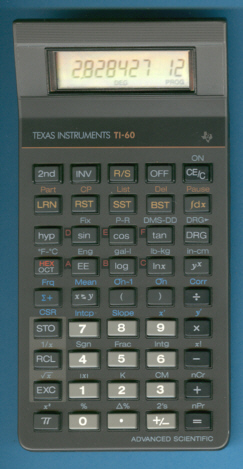
TI-60 Advanced Scientific calculator is somewhat different from the other
members of the second generation slanted family. If you compare it with the TI-55
III
you will notice first a black instead of a silver housing and second another
display.
The
TI-60 Advanced Scientific calculator is somewhat different from the other
members of the second generation slanted family. If you compare it with the TI-55
III
you will notice first a black instead of a silver housing and second another
display.
All other slanted calculators offer you a mantissa of 8 digits and 2 exponents, the TI-60 uses 10 digits to display either the mantissa or combine 7 digits mantissa and 2 exponents. The reason is the enhanced precision of internal calculations, here you get similar performance like the TI-62 and TI-65 of the Galaxy line.
The TI-60 is one of the famous "nearly programmable" calculators, you can store up to 84 key-codes in a permanent memory shared with the storage place for the statistical calculations and user memory.
 Inside
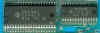
the calculator you'll find once again the two-chip design of most slanted calculators
that allowed more
features compared to the slimline series.
Inside
the calculator you'll find once again the two-chip design of most slanted calculators
that allowed more
features compared to the slimline series.
Instead of the two TP0456
based chips of the TI-55-II you'll find here a TP0458
Primary chip with a TP0456 Secondary chip.
The design of the TI-60 was changed in 1990 slightly, please compare the bottom line of
a later TI-60:
| • 1986: ADVANCED SCIENTIFIC • 1990: PROGRAMMABLE SCIENTIFIC |
There are no differences between the TI-60 manufactured in Italy or an US-built TI-60.
If you are interested in the calculating accuracy of scientific calculators don't miss the Calculator forensics.
Like usual there is a counterpart for financial purposes,
don't miss the rare BA-III calculator.

If you have additions to the above article please email: joerg@datamath.org.
© Joerg Woerner, October 26, 2007. No reprints without written permission.