DATAMATH CALCULATOR MUSEUM
|
DATAMATH CALCULATOR MUSEUM |
Texas Instruments TI-35
| Date of introduction: | 1979 | Display technology: | LCD |
| New price: | $33.00 $21.95 (SRP Sep. 1980) |
Display size: | 8 (5 + 2) |
| Size: | 5.3" x 2.9" x
0.35" 134 x 74 x 9 mm3 |
||
| Weight: | 2.9 ounces, 82 grams | Serial No: | 3522386 |
| Batteries: | 2*LR43 | Date of manufacture: | wk 48 year 1980 |
| AC-Adapter: | Origin of manufacture: | USA (ATA) | |
| Precision: | 11 | Integrated circuits: | TP0324-4NL |
| Memories: | 1 | ||
| Program steps: | Courtesy of: | Joerg Woerner |

 The
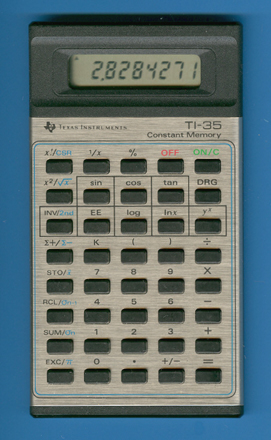
TI-35 was the next calculator following the TI-50 in the slimline epoch.
Differences in functionality were small, in appearance great. Compared to the
design of the TI-50 or TI-53 with their metal housing and molded keys this one
looks really cheap. TI corrected this "failure" later with a stylistic
enhanced TI-35. Compare it for your own.
The
TI-35 was the next calculator following the TI-50 in the slimline epoch.
Differences in functionality were small, in appearance great. Compared to the
design of the TI-50 or TI-53 with their metal housing and molded keys this one
looks really cheap. TI corrected this "failure" later with a stylistic
enhanced TI-35. Compare it for your own.
Simply by comparing the designation of the integrated circuits of the calculators you'll get the first members of the slimline family:
| • TP0320 (CD3201)
TI
Investment Analyst • TP0320 (CD3202) TI-30-II • TP0321 TI-50 • TP0322 TI-Business Analyst-II • TP0323 TI-53 • TP0324 TI-35 • TP0326 TI-38 and TI-20 |
Don't miss the rare Business Card, probably the missing calculator using one of the TP032x chips.
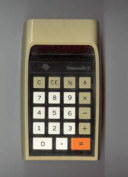
If you dig deeper into the early slimline calculators you'll notice two different designs of the keys itself. The cheap looking black keys like the ones on the left (1979) or the engraved keys started in the year 1978 with the TI-50. Some calculators used both keyboard:
| Old style keyboard | New style keyboard | ||
| Calculator | Introduced | Calculator | Introduced |
| TI-30 II | 1982 | TI-30 II | 1982 |
| TI-35 | 1979 | TI-35 | 1982 |
A similar calculator was introduced with the TI-38. In Brazil a similar calculator was advertised as TI-35B.
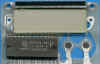 In 1978 Texas Instruments
introduced the first CMOS calculator chips based on the TMS1000
Microcomputer family. The TP0320 architecture is similar to the
TMC0980
chips introduced two years earlier for the TI-30 calculator.
Main disadvantage of this family was the limited capacity with just 2k*9 bits ROM and
576 bits RAM (TMC0980, 9*16*4 bits) or 768 bits RAM (TP0320, 12*16*4 bits)
resulting in simplified and sometimes inaccurate calculating algorithm.
In 1978 Texas Instruments
introduced the first CMOS calculator chips based on the TMS1000
Microcomputer family. The TP0320 architecture is similar to the
TMC0980
chips introduced two years earlier for the TI-30 calculator.
Main disadvantage of this family was the limited capacity with just 2k*9 bits ROM and
576 bits RAM (TMC0980, 9*16*4 bits) or 768 bits RAM (TP0320, 12*16*4 bits)
resulting in simplified and sometimes inaccurate calculating algorithm.
The next generation of enhanced C-MOS calculator chips was
introduced in 1981 with the TP0455 resp. TP0456 family. The third edition of
the TI-35 received during its production time an
upgrade to the CD4557 chip and the accuracy of e.g. the Calculator
forensics test increased slightly:
| Forensics Test (expected: 9.0000000) | ||
| Calculator | Chip | Result |
| TI-35 (1979) | TP0324-4N | 9.177087103 |
| TI-35 (1980) | TP0324-4NL | 9.177087088 |
| TI-35 (1982) | CD4557 | 9.114640577 |
Recently an early TI-35 with a Calculator forensics test result of 9.177087103 was reported. We noticed two minor differences: The calculator chips reads TP0324-4N instead the common TP0324-4NL designation and the finish of the keyboard plate looks different.
In 1984 the era of the slimline calculators was over and Texas Instruments introduced a family of four calculators manufactured in Taiwan:
| • TI-30 III • TI-35 II • BA-II • BA-35 |
If you are interested in the calculating accuracy of scientific calculators don't miss the Calculator forensics.
The US based company Jeppesen Sanderson developed a very
interesting navigation computer called avstar based on
this TI-35. Don't miss the
MicroManager using
a very similar approach for a completely different application.
| TI-35 Student Math Kit
Problem-solving kit with Slimline TI-35 scientific calculator. The powerful 54-function calculator is truly pocket portable and performs the most-needed slice rule functions as well as PI, factorial and constant for rapid calculations of even complex problems. Its bright, liquid display crystal display with scientific notation lets you work with even the smallest or largest numbers with ease. Built-in statistical capabilities include data entry, mean and standard deviation for both sample and population data. Versatile 4-key Constant Memory* feature lets you store, recall, sum data to memory and exchange memory with display. And it retains your data even when the calculator is off. © Texas Instruments, 1981 |

If you have additions to the above article please email: joerg@datamath.org.
© Joerg Woerner, December 5, 2001. No reprints without written permission.