DATAMATH CALCULATOR MUSEUM
|
DATAMATH CALCULATOR MUSEUM |
Texas Instruments STATISTICS Solid State Software Cartridge (Prototype)
| Date of introduction: | (1983) | Display technology: | |
| New price: | $59.95 (MSRP 1983) | Display size: | |
| Size: | 1.8" x 2.0" x 0.50" 46 x 52 x 13 mm3 |
||
| Weight: | 0.9 ounces, 26 grams | Serial No: | |
| Batteries: | n.a. | Date of manufacture: | wk 49 year 1982 |
| AC-Adapter: | Origin of manufacture: | USA | |
| Precision: | Integrated circuits: | HN61256P | |
| Memories: | |||
| Program steps: | Courtesy of: | Brian Green |
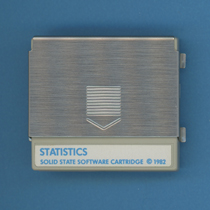
 The
STATISTICS Solid State Software Cartridge (SSSC) was developed by Texas
Instruments for its CC-40 Compact Computer System and
contains 14 easy-to-use programs chosen to serve a broad range of statistical
applications:
The
STATISTICS Solid State Software Cartridge (SSSC) was developed by Texas
Instruments for its CC-40 Compact Computer System and
contains 14 easy-to-use programs chosen to serve a broad range of statistical
applications:
|
• Descriptive Statistics - Histogram • Descriptive Statistics - Means and Moments • Parametric Tests - T-Test Paired Observations • Parametric Tests - T-Test Unpaired Observations • Non-Parametric Tests - Contingency Table Analysis • Non-Parametric Tests - Mann-Whitney Rank-Sum Test • Analysis of Variance - One-Way ANOVA • Analysis of Variance - Two-Way ANOVA • Theoretical Distributions - Binominal Distribution • Theoretical Distributions - Chi-Square Distribution • Theoretical Distributions - F-Distribution • Theoretical Distributions - Normal Distribution • Theoretical Distributions - Poisson Distribution • Theoretical Distributions - Student's T-Distribution |
 This early prototype of the STATISTICS SSSC uses a different form factor and electrical
connector than the final SS-3008 STATISTICS SSSC and
fits only with the never released prototypes of the Compact
Computer 40.
This early prototype of the STATISTICS SSSC uses a different form factor and electrical
connector than the final SS-3008 STATISTICS SSSC and
fits only with the never released prototypes of the Compact
Computer 40.
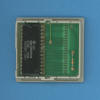
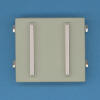 Dismantling this Solid State Software Cartridge manufactured in
March 1984 by Texas Instruments in their Lubbock, Texas facility, reveals a small printed circuit board (PCB) with
a HN61256P ROM (Read-Only Memory) manufactured by Hitachi, Japan.
Dismantling this Solid State Software Cartridge manufactured in
March 1984 by Texas Instruments in their Lubbock, Texas facility, reveals a small printed circuit board (PCB) with
a HN61256P ROM (Read-Only Memory) manufactured by Hitachi, Japan.
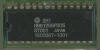 The HN61256P
uses a CMOS process resulting in a very low power consumption of 7.5 mW and
features a capacity of 32k Bytes with an access time of 3.5 us.
The HN61256P
uses a CMOS process resulting in a very low power consumption of 7.5 mW and
features a capacity of 32k Bytes with an access time of 3.5 us.

If you have additions to the above article please email: joerg@datamath.org.
© Joerg Woerner, December 27, 2020. No reprints without written permission.