DATAMATH CALCULATOR MUSEUM
|
DATAMATH CALCULATOR MUSEUM |
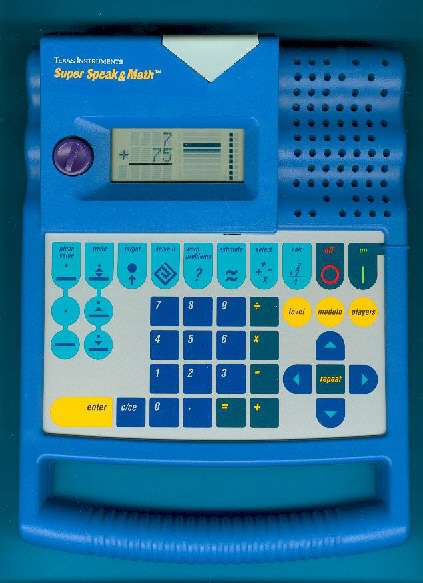
Texas Instruments Super Speak & Math
| Date of introduction: | 1990 | Display technology: | LCD |
| New price: | $38.25 (1992) Libraries: $19.95 |
Display size: | 2*8 alphanumeric |
| Size: | 10.7" x 8.0" x
2.1" 271 x 203 x 53 mm3 |
||
| Weight: | 18.9 ounces, 535 grams | Serial No: | |
| Batteries: | 4*AA cells | Date of manufacture: | wk 09 year 1991 |
| AC-Adapter: | Origin of manufacture: | USA | |
| Precision: | Integrated circuits: | TSP50C10 (CSM10047), TSP60C18 (CMM18001), Samsung KS0062 |
|
| Memories: | |||
| Program steps: | Courtesy of: | Joerg Woerner | |
| Download manual: |  (US: 9.1M Bytes)
 |
 With
the Super Speak & line Texas Instruments introduced educational toys similar
to the well known kids-computers with there small LCD-screens and
ASCII-keyboards. Don't miss the Super Speak
& Spell.
With
the Super Speak & line Texas Instruments introduced educational toys similar
to the well known kids-computers with there small LCD-screens and
ASCII-keyboards. Don't miss the Super Speak
& Spell.
Dismantling this Super Speak & Math manufactured in October 1989 by Texas Instruments in the United States reveals a clean design centered around just three Integrated Circuits:
|
• TSP50C10/CSM10047: TSP50C50 VSP (Voice Synthesis Processor) with 8-bit microcontroller and
16k Bytes Mask ROM for both program and voice and 128 Bytes + 16 Nibbles RAM • TSP60C18/CMM18001: VSM (Voice Synthesis Memory) with 256k Bits • Samsung KS0062: LCD Controller for monochrome dot matrix liquid crystal display with 8-bit Interface |
The Super Speak & Math is the successor of the Speak & Math.
You'll find more games for younger children in the Computer Fun.
Super Speak & Math will do:
| • Place Value - teaches the place-value system in representing one and two digit numbers • Trade - reinforces understanding of the place-value system • Target - emphasizes logical reasoning and problem-solving • Solve It - Uses the place-value system to develop logical reasoning • Math Problems - tests your knowledge of basic mathematical terms and facts • Estimate - develops the ability to estimate answers to problems • Select - helps you to recognize basic math operations • Calculator - provides the opportunity to make up and solve your own math problems |
The toy is intended for players ages 6 to 12.
Two Super Speak & Math Expansion Cartridges are known:

If you have additions to the above article please email: joerg@datamath.org.
© Joerg Woerner, December 5, 2001. No reprints without written permission.

