DATAMATH CALCULATOR MUSEUM
|
DATAMATH CALCULATOR MUSEUM |
navtronic 1701t
| Date of introduction: | 1979 | Display technology: | LED-stick |
| New price: | $199.50 (1980) | Display size: | 12 |
| Size: | 5.9" x 3.2" x
1.5" 150 x 81 x 39 mm3 |
||
| Weight: | 8.0 ounces, 227 grams | Serial No: | 3852 |
| Batteries: | 3*AA NiCd | Date of manufacture: | year 1979 |
| AC-Adapter: | Origin of manufacture: | USA | |
| Precision: | 8 | Integrated circuits: | MM5782, MM57129, MM5368, ITC1200, ITC1210, ITC4800, 2*ITC5028 |
| Memories: | |||
| Program steps: | Courtesy of: | Joerg Woerner | |
| Download manual: |  (US: 4.3 MByte)
 |
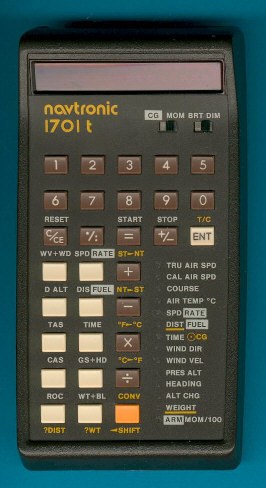
 The
navtronic 1701t is based on the earlier navtronic 16 but added a
physical protection to the 14
LED-indicators on the keyboard panel.
The
navtronic 1701t is based on the earlier navtronic 16 but added a
physical protection to the 14
LED-indicators on the keyboard panel.
The 1701t is one of four very similar flight computers:
|
• navtronic
1701: Basic navigation calculator • navtronic 1701t: Added TIMER function (START, STOP keys) • navtronic 1701r: RNAV functions (R1, R2, D1, D2 LED-indicators) • navtronic 1701tr: TIMER and RNAV functions |
If we trace back in the history of electronic flight computers we discover: The Commodore N-60, the Heathkit OCW-1401 and the navtronic 16 resp. navtronic 1701 models. All were introduced around the year 1978, two years before the Jeppesen Sanderson avstar based on a Texas Instruments TI-35 appeared.
In 1983 with the Navigator and Explorer enhanced flight computers were introduced.
There are some rumors that the "1701 series" got it designations as a nod to Star Trek, the U.S.S. Enterprise is #1701. The 1701 itself comes from "FAA registry of a Waco biplane, owned by TOS chief designer Matt Jefferies".

If you have additions to the above article please email: joerg@datamath.org.
© Joerg Woerner, February 3, 2002. No reprints without written permission.