DATAMATH CALCULATOR MUSEUM
|
DATAMATH CALCULATOR MUSEUM |
CASIO fx-7000G
| Date of introduction: | October 1985 | Display technology: | LCD dot matrix |
| New price: | $90.00 (SRP 1988) | Display size: | 8 * 16 characters |
| Size: | 6.5" x 3.2" x 0.6" 165 x 82 x 15 mm3 |
||
| Weight: | 5.4 ounces, 152 grams | Serial No: | 7D307A |
| Batteries: | 3*CR2032 | Date of manufacture: | year 1987 |
| AC-Adapter: | Origin of manufacture: | Japan | |
| Precision: | 13 | Integrated circuits: | CPU: NEC uPD1007G-008 RAM: Toshiba TC5518 Display: 2* Hitachi HD44351, HD44350 |
| Memories: | 26-78 | ||
| Program steps: | 422-6 steps + 127 steps volatile |
Courtesy of: | Joerg Woerner |
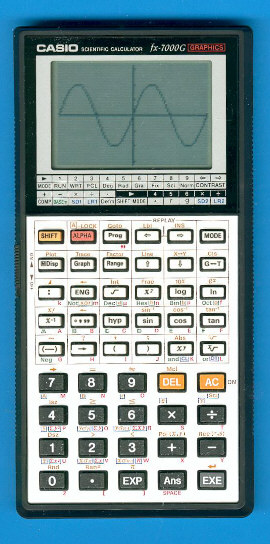
 It
was a milestone in the history of pocket calculators when Casio introduced with
the fx-7000G the World's first Graphing calculator. The display could be
switched between the character mode offering 8 lines of 16 characters each, and
a pure graphics mode with an array of 63*95 addressable dots. Even todays
Graphing calculators like the TI-83
Plus kept this display format, main differences are the data and program
memory sizes. Instead of limited 422 program steps todays calculators deal with
megabyte instead the bytes.
It
was a milestone in the history of pocket calculators when Casio introduced with
the fx-7000G the World's first Graphing calculator. The display could be
switched between the character mode offering 8 lines of 16 characters each, and
a pure graphics mode with an array of 63*95 addressable dots. Even todays
Graphing calculators like the TI-83
Plus kept this display format, main differences are the data and program
memory sizes. Instead of limited 422 program steps todays calculators deal with
megabyte instead the bytes.
 Dismantling
the Casio fx-7000G and comparing with the later TI-81
reveals some surprises. The TI-81, introduced already 5 years later than the
fx-7000G, uses almost identical hardware.
Dismantling
the Casio fx-7000G and comparing with the later TI-81
reveals some surprises. The TI-81, introduced already 5 years later than the
fx-7000G, uses almost identical hardware.
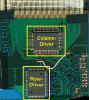
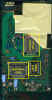 The
main printed circuit board (PCB) of the fx-7000G with only two components:
The application specific CPU uPD1007G-008 manufactured by NEC, probably based
on a Z80 and a 2k*8 RAM. The later TI-81 uses a 8-bit microprocessor of the Z80 family, a huge ROM of 128k Byte
capacity, and a RAM of 8k Byte size.
The
main printed circuit board (PCB) of the fx-7000G with only two components:
The application specific CPU uPD1007G-008 manufactured by NEC, probably based
on a Z80 and a 2k*8 RAM. The later TI-81 uses a 8-bit microprocessor of the Z80 family, a huge ROM of 128k Byte
capacity, and a RAM of 8k Byte size.

If you have additions to the above article please email: joerg@datamath.org.
© Joerg Woerner, February 28, 2004. No reprints without written permission.